
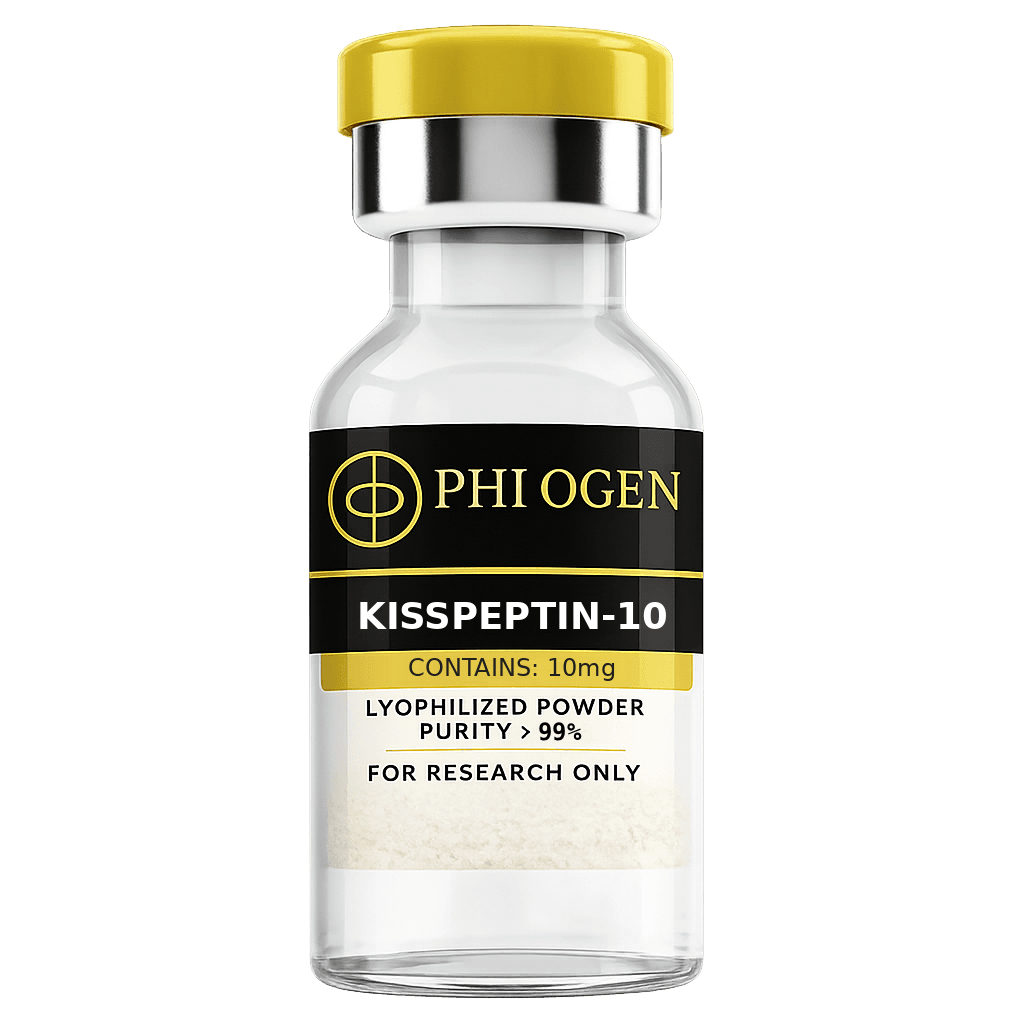
Kisspeptin-10 10mg
Hypothalamic neuropeptide for HPG axis activation, testosterone, and libido.
Kisspeptin-10 — Melanocortin System Research
Within the melanocortin-system literature, Kisspeptin-10 is produced in the hypothalamus and plays a critical role in regulating the HPG (hypothalamic-pituitary-gonadal) axis. It stimulates GnRH release, leading to downstream LH and FSH secretion. Studies show applications in fertility research, testosterone restoration, libido support, and hormonal balance for both sexes.
Primary research applications for Kisspeptin-10 include hpg axis activation via gnrh stimulation, lh and fsh secretion increase, testosterone and reproductive hormone support, libido enhancement in preclinical models. As a Melanocortin compound, it is studied in the context of reproductive, hormone, hpg axis — areas where its mechanism of action has the most direct relevance in preclinical models.
In standard research protocols, Kisspeptin-10 is administered at 100–500 mcg subcutaneous as needed, with a half-life of Minutes to 1 hour. This product is supplied by Phiogen as lyophilized powder with independent third-party Certificate of Analysis (COA) documentation confirming 99%+ purity and correct molecular identity on every batch. Kisspeptin-10 10mg is sold strictly for laboratory and educational use only — it is not FDA-approved for human therapeutic use and is not intended for human consumption, clinical application, or use in animals.
Reconstitution Calculator
Calculate exact BAC water volume and dose measurements for Kisspeptin-10 10mg.
For laboratory use only. This calculator is a reference tool — verify all calculations before use. Always use sterile technique with bacteriostatic water and sterile syringes.
Frequently Asked Questions
What is the role of kisspeptin in the HPG axis?
Kisspeptin is recognized as the dominant activator of GnRH neurons in the hypothalamus and is considered essential for reproductive competence. Kisspeptin-expressing neurons in the arcuate nucleus form the core of the GnRH pulse generator and integrate signals from sex steroids, metabolic status, and environmental cues to regulate reproductive timing. Loss-of-function mutations in KISS1 or GPR54 cause hypogonadotropic hypogonadism and absent puberty, establishing kisspeptin's indispensable role.
Why is kisspeptin-10 studied rather than full-length kisspeptin peptides?
The kisspeptin family includes isoforms of 54, 14, 13, and 10 amino acids, all derived from the C-terminal region of the KISS1 precursor protein. Kisspeptin-10 is the smallest fragment that retains full GPR54 receptor binding and bioactivity in pharmacological studies. Its smaller size makes it easier and more cost-effective to synthesize, and its receptor affinity has been characterized extensively in both in vitro binding assays and in vivo functional studies.
Can kisspeptin-10 be used to study fertility-related signaling?
Yes, kisspeptin-10 is widely used as a scientific tool to interrogate HPG axis function, with particular applications in models of hypothalamic amenorrhea, GnRH deficiency, and reproductive aging. In human clinical pharmacology studies, intravenous kisspeptin-10 reliably stimulates LH pulses within minutes, enabling real-time assessment of GnRH neuron responsiveness. It has also been investigated as a trigger for oocyte maturation in IVF protocols as an alternative to hCG.
Effectiveness Profile
Relative effectiveness scores derived from published preclinical literature across key endpoints.
Scores are qualitative aggregates from animal and in vitro studies and are not a medical claim. For educational purposes only.
Effect Timeline
Expected milestones based on published preclinical data.
Central melanocortin receptor engagement within hours. Acute libido and mood effects in preclinical models.
Melanin synthesis stimulation begins (for tanning peptides). Libido enhancement effects become measurable.
Maximum libido and pigmentation effects established in preclinical models. HPG axis stimulation measurable.
Effects sustained with reduced maintenance dosing. Hormonal balance improvements stabilize.
Central melanocortin receptor engagement within hours. Acute libido and mood effects in preclinical models.
Melanin synthesis stimulation begins (for tanning peptides). Libido enhancement effects become measurable.
Maximum libido and pigmentation effects established in preclinical models. HPG axis stimulation measurable.
Effects sustained with reduced maintenance dosing. Hormonal balance improvements stabilize.
Timelines are derived from preclinical animal studies. Individual results in laboratory settings may vary. For educational purposes only.
Applications & Benefits
Dosing Protocol
Dosing information is derived from published animal studies and is provided for educational purposes only.
🔬 Mechanism of Action
Kisspeptin-10 is the shortest biologically active fragment (residues 45–54) of the kisspeptin family of neuropeptides, which are encoded by the KISS1 gene. It acts as an endogenous ligand for the GPR54 receptor (also known as KISS1R), expressed on GnRH neurons in the hypothalamus. Kisspeptin-10 stimulates GnRH neuron depolarization and pulsatile GnRH release into the hypophyseal portal circulation, which in turn drives LH and FSH secretion from the anterior pituitary — positioning it as a master regulator of the hypothalamic-pituitary-gonadal (HPG) axis.
Key Study Findings
Intravenous and intranasal kisspeptin-10 administration stimulates robust LH and GnRH pulses in healthy human volunteers in pharmacological studies
Studies demonstrate kisspeptin's role as the central activator of pubertal onset and reproductive axis maturation
Shown to restore LH pulsatility in models of hypothalamic amenorrhea and GnRH deficiency
Kisspeptin neurons in the arcuate nucleus are key components of the GnRH pulse generator circuit in mammals
Studied for its effects on sexual behavior and partner preference in animal models via limbic system kisspeptin receptor expression
Related Topics
Kisspeptin-10
For educational use only · Verified vendor
Quality Assurance
Related Guides
Kisspeptin-10 5mg
Kisspeptin-10 5mg — HPG axis activation and reproductive hormone regulation.
Melanotan I 10mg
Linear α-MSH analog — melanin production and UV-protective tanning without sexual side effects.
Melanotan II 10mg
Cyclic α-MSH analog — tanning, libido enhancement, and appetite regulation.